Saturday, October 24, 2009

RAPE OF THE MOTHER


There is a saying in South Africa when you hit a woman you strike a rock.
Credo Mutwa, High Sanusi said it to me this way, when you strike a woman you strike your mother. "When the men entered the mines they were forever changed, it was like raping their own mother." It went against their traditional beliefs and culture.

Himself a miner in days gone by, Credo was speaking with much pain about the deep suffering of men who went into the mines to drill, and excavate the land for minerals. The land that had been taken from them, the land that was sacred to all indigenous peoples, the land that nourishes and nurtures. It was now the same white men who stole their land that oversaw the Africans as they penetrated deep into the mother, not to sew their seeds of new life, but to rip apart the very source of connection that had fed them, their home and their patriachial heritage, it felt, like we were raping our mothers.

Here in the USA during slavery, men had to watch as their women were sold and or raped, and could not do anything about it. Now the continuing removal of black men from their families, through the injustice system, where there is little or no rehabilitation or reconciliation work, does nothing but continues to foster a culture that continues to turn in on ourselves

I sit with a heaviness that asked me to look at the correlation of all this. That with this continuing violence and abuse of women and young girls, the remnants of the desmasculation of men during apartheid and slavery in the USA, is a continuing rape of the mother, in the most violating way and until the healing is done with and for the men, and for those who continue to pull the veil over the roots of this, how and when will the violation stop?

In South Africa rape is being called a silent war on women and children with many thousands of rapes going unreported and unpunished, but the fact is, during a parliamentary debate it was reported that there has been a 400% increase in the sexual violence against children over the past decade. A child is raped in South Africa every three minutes!

Apartheid and slavery have sewn seeds not only for the breakdown of the family, but the breakdown of a value system that is deeper than any monetary system in existence or ever will be. Value of self, value of another, value of women. It is a rupture of the deep self that has left a gaping hole, unable to be filled in my lifetime with promises of raising a new land of infinite possibilities.

A new South Africa has an epidemic and its not only HIV, it is a turning in on ourselves and each other. A dis-ease of the gravest kind and it is called rape of the woman, when you rape a woman you are raping your mother and grandmother. It is an epidemic that is spreading far and wide and it is a killer.

Apartheid I am told is over. It is not over until those who are the gatekeepers of this tragically beautiful land, realize that with the continuing violation of women, a New South Africa cannot strengthen its foundation, cannot nurture and nourish each other and cannot give birth to healing reconciliation. Whilst punishment is dealt out there needs also be a restorative justice offering that looks into the deeper roots of the this raging dis-ease that provides an opportunity for healing both victim and perpetrator, teachings that would would hold those accountable by honoring the sacredness of women. Not only does it require the men to teach their brothers but it is the women that must also teach the men, this is a family affair.

This turning in on ourselves and each other, is a fire borne out of years of a silenced internal war where in the new South Africa the main target are women and children. It is not new, it is a conditioning deep in any collective dominance, wether it be male,white or black-conquer no matter what. It was once sung our only sin is that we are black, in that men and women were united, now it is, our only sin is that we are women. Rape is not an option for oppression, nor is it a violent entitlement in response to South Africa's violent past, it is a gross violation of the sacred Divine Feminine.


Sunday, July 12, 2009

The Pass Book and the Sharpville Massacre


I am choosing to write about this today because yesterday I received my Identity Document book for South Africa. The history and metamorphosis of this book is long and carries with it a stigma of the past oppression during the struggle of apartheid. 
Receiving this felt like a huge milestone for me after 55 years. I am now a citizen of South Africa, something I know my parents would be rejoicing and I have the infamous pass book revised many times to now be called an Identity Document. 

During the fifties the apartheid government was continually introducing new means to surpress the liberation struggle.  The longest battle and the most bitter of them the ANC fought was against the Pass Laws. 

Pass laws were designed to control the freedom of movement of Africans under apartheid. Imposed by the Dutch and British in the 18th and 19th century slave economy of the Cape colony. The 19th century saw a change in the regulation to ensure a reliable cheap supply of African Labor for the mines, predominantly gold and diamond. 

And in 1952 a reference book was mandated for all African males over the age of 16 . This contained employment history and personal information. 
Initially it was only men who had to carry a pass book by law. The pass book said you were allowed to work and where you could work. You could not get a job without this book. The police could stop you at anytime and ask to see this  book. If you did not carry it on you,  it resulted in arrest. Then in the early fifties the government made black women carry pass books as well.

The federation of South African Women was a non racial organization which mobolized women in protest against apartheid in general, and the introduction of passes for women in particular. It was formed in 1954 the year our family left South Africa, by women in the Congress alliance. One of its many aims was to combat sexism within the various Congress Alliance organizations.
In 1956 20,000 women marched in protest to the Union Buildings in Pretoria on August 9 to campaign against the imposition of pass laws on women. This day is now a national holiday in South Africa, Womens Day. The Federation of South African Women was never banned but as a result of its formation many of its members were forced into exile, or detained in the 1960s.      

The violation of this law was frequent, as Africans sought work to support their families and finally they protested these humiliating laws which fueled the apartheid struggle. The defiance Campaign (1952-54)the massive  women's protest in Pretoria (1956)to the burning of passes at the police station at Sharpville where 69 protesters were massacred  (March 21, 1960)when police opened fire on approximately 300 unarmed peaceful demonstrators, many were women who were protesting about the pass laws.

The 1970s and 1980s saw a radical stance around violation of pass laws. Many Africans were stripped of citizenship, and deported to rural homelands, already poverty stricken. 17 million arrests had been carried out by  the expensive and ineffective pass laws that were finally repealed in 1986!

The pass laws, the massacres were more gross violations of human rights during the Apartheid regime. It is a tribute to my parents to know that I can return and more importantly, want to return again and again to the homeland where I can now should I wish "lay my hat" for all those who were exiled and could not return, those who were or arrested, those who died, or like me did not want to return.  

Inkululeko (Freedom)  

Sunday, June 21, 2009

Honoring Our Fathers


When ever I return home from South Africa or London, I hear more stories and see more photos of my father, as I did  not know much about his history.   A plethora of mixed emotions that makes me sad (because there was much I did not know and joyful because I discover more about him each time ) He died in Spain, when I was 24 years old on the way back to England and on the way to my wedding. He died of a heart attack, in Spain (where he had said he wanted to be buried)  but I believe it was a broken heart having to leave his homeland South Africa and all his family. Recently I found out about his activism as a young man, it filled me with joy as I had found a connection to him.


He grew up in a household of all women, and I believe often escaped to a shed at the bottom of the garden. He loved to read, always in a book even at the dinner table. Plagued with bronchitis and the bitter winters and fog in London, we would also often find him poured over a bowl of vick water a towel draped over his head.  I often used to climb into bed when he was sick and he would teach me my French for the day. All the words I remember today are remnants of my father’s teachings, I do not remember a thing I was taught in school. He was a teacher, loved by his students in South Africa, I was told recently. A great football player, captain of his team, and a lover of History and studying form! Before we had a phone in the house he could be found in the red telephone box on the corner of our street, with the blue book, placing bets. A liberal man who did not suffer fools . My mother would throw parties and my father would often dissapear with a book to bed. 

I do not remember one word of reprimand to me or maybe I just do not want to remember, as I adored him. 


I mention this as it is all part of his history that shaped who he was. Part of what I do is to help people to heal what I am calling the wounds of ancestral legacy. That which shaped our mothers and fathers, their fathers, grandfathers and ulimately us, how we show up today. I am well aware that not everyone has good memories of their father or may not even want to remember him, and so when Father’s Day comes along it may be hard for some. What has been helpful is to be curious about this man who gave us life, who is a part of us, and to also discover what it was like for him growing up which may have contributed to how he showed up as your father. With whom, can or could he, the father, share his wound when the messages often received were as kids  “big boys do not cry” and continuing into adulthood that the man of the house is expected to provide.  


Fathers who leave, and it seems stastically to be more than mothers, are often left in our memories as Superman or we stay mad at them or worse still we blame ourselves for their behaviuor and constantly look for validation from other men who come into our life. 


 My experience was confusing. Knowing I was loved and Daddy’s little girl (the only girl in the family) yet my Father did not know how to express his love. When I heard the stories of his family growing up I understood why and could forgive. You may not be able to forgive, and some may have amazing wonderful fathers. I can only imagine it is  a huge responsibility taking care of children, as it is a huge responsibility to provide for your family for years, maybe having to give up dreams. 


   The father wound cuts deep for daughters and sons as it does not neccesarily hold the notion of unconditional love as the mother is supposed to represent. We are constantly looking for validation, a role model and someone to be proud of, someone strong  and when he fails in one or all, it can be devastating and when he does not see our gifts it can wound us for life.   What ever your experience of your father, alive or passed I invite you to  “find the blessing alongside the wound” Michael  Meade.  Generally I feel men and Fathers get a bad rap in this society ( I hear the screams from some women as I write this)  but when I have sat in San Quentin mens prison and heard the men’s  stories or when I hear the stories of client’s fathers and grandfathers actions in divination, it remnds me that we ALL have a story and maybe no one  has bothered to take the time to listen to them. I am deeply regretful to not have a father to tell me stories of our families legacy, and that I never knew my grandfather in the male lineage, it holds a rich legacy. So make the most of it while they are still here.


They say when the father dies your life work begins and so it is 


Thursday, November 27, 2008

Mama Africa, Miriam Makeba (1932-2008)

I awoke this Thanksgiving morning with the song of Wimoweh in my head. And I wanted to say thank you (Ngiyabonga)  to one of my heroines.  As a child I will always remember hearing Miriam Makeba songs in our household. It was our family's connection to South Africa, when we moved to London in 1954. Just five years later in 1959, at the age of 27, Makeba's passport was revoked for criticizing apartheid, she was banned from returning home, and did not see South Africa for the next 30 years. Described  as "our own nut brown baby" by the Manhattan Brothers and having the voice of a "nightingale"  Makeba not only brought to her work a presence of deep soul,  passion and a unique brand of music but she never forgot the struggle of her people in South Africa, often using her songs to tell the story. 

I believe it was her way to stay connected to the beloved country that she was tragically exiled from. It is an act of violence and abuse on every level to prevent a human being from returning to their homeland, and its impact-and  I am without a doubt, was a slow wearing away of the spirit. But despite the pain she felt, like Paul Robeson, the African American singer, actor and activist, who lived for many years in exile from the USA,  she never gave up, always stepping up to the opportunity to speak out, using her worldwide fame to bring attention to the abomination and iron cage of apartheid that kept her away from her family.  

Whether she was singing about the ghettos, celebration, hunger, or in many languages (her own being Xhosa) she inspired a sense of hope in us, and her music represents a cry from the heart, becoming the voice of South Africa.  She wrote in her autobiography, Makeba My Story: 
"It was the Superior Being that gave me a voice to sing with, but it was my mother and grandmother who gave me my first words to sing..."  


Her mother was a sangoma. Traditionally in South Africa a sangoma divines the future through the wisdom of the ancestors, heals the sick, and guides others around them. In her book she tells the story of wearing the robe of her mother on stage , and every so often when she did she would not be conscious of the songs she sang. I myself find that in the practice of divining, I cannot remember what I said. It is the ancestors working through me. A friend of hers who knew about sangomas and the spirit of amadlozi suggested that the amadlozi were stealing the show! She thought that like her mother she too was possessed by spirits, and she then wondered about her only child.  Her own pain around her daughter, her disappearances, her sickness and final death caused Makeba  much grief and worry.  She finally consulted a sangoma. Makeba's own belief was that it was the enforced exile upon her and so her daughter, among other things, that contributed to her daughter's sickness.    

She was a committed Pan Africanist who was welcomed anywhere in the world. After one of her four husbands, (who also included Hugh Masakela) Stokely Carmichael, the radical civil rights campaigner who fell into trouble with the authorities in the USA , she opted for exile in Guinea.
   
Mama Africa died of a heart attack  (or was it a broken  heart) after performing on stage, at the age of 76. She was a mother and a grandmother and was loved the world over. I can only hope that it felt like the perfect world she describes in her book.
"Going on stage to sing is like stepping into a perfect world. All that matters is the music, I live for this. And the message the few heartfelt words that I say to plead for my people, this makes it even more perfect. The concert stage: This is the one place where I am most at home, where there is no exile.  If I die on stage I guess I will be the happiest person, because I will be dying like a soldier on the battlefield. "  (from Makeba My Story )
I have been struck by her autobiography, in particular her humility and shyness despite her world adoration and fame. This is a striking contrast in the few clips I have seen of her perform. She transmits confidence, boldness and a powerful presence that never showed her troubles.

Mama Afrika my personal invocation to you: "Welcome home Mama Afrika, may you rest in peace knowing you are free, you are on my ancestral alter to remind me of your strength, resilliance and courage in the face of struggle. Help us to remember to never give up. Be an ally to us when we are human and  vulnerable. You embodied grace, dignity, humility. Remind me of all of this. Nudge me to continue singing the songs of South Africa. They are the songs that speak of justice and freedom, which are rightly ours" 


Sunday, June 1, 2008

Truth and Reconciliation-Xenophobia comes to remind us

"Breaking the Silence" Madelaine Georgette


I need to know what and how to do what they are doing
I need to know how to forgive
even when the cruel ones won't admit
they have been cruel
I need to join in this experiment of living compassion
so that my heart can open its wings
and at last be free
Everyone needs to understand the secret of this deep and honest way
It is the great mystery of compassion that awaits us all
Oh my African brothers and sisters
teach us with your soft talk of tribal spirit
how to eat the truth and bow to ourselves

Mark Nepo
marknepo.com

I was moved to write about this as I heard a black South African share that his people's trauma of apartheid is now surfacing and that there is much healing to be done. One wonders in the face of the recent xenophobia attacks, if in fact there has been much change in the new South Africa when the people are turning on their own brothers and sisters but calling it Xenophobia. It seems for me that the connection needs to be re remembered. Xenophobia is a fear or contempt of that which is foreign or unknown, especially of strangers or foreign people. It comes from the Greek words, xenos meaning "foreigner" "stranger" and phobos, meaning fear 
 Wikepedia  

  April 27 1994, marked the day that all people could vote in South Africa, Archbishop Desmond Tutu was sixty two years old and Nelson Mandela was seventy six! The lines that formed that day and the hours that they had to wait helped people to find each other. They discovered not a Colored, a Black, a White or an Indian. They found other humans who had the same hopes, dreams and concerns. They found fellow South Africans that shared a common humanity. Ubuntu

However few sections of society in South Africa were left untouched by violence in the final decade of South Africa's last white government. South Africa in an effort to rehabilitate their nation, established a great national experiment, the Truth and Reconcilliation Commitee. "Our nation sought to rehabilitate and affirm the dignity and personhood of those who for so long had been silenced, had been turned into annonymous, marginalized ones. Now they would be able to tell their stories, they would remember and in remembering would be acknowledged to be persons with an inalienable personhood." Archbishop Desmond Tutu.
Tutu's book "No Future without Forgiveness"  is a personal memoir of his chair of the TRC  
Ubuntu he says was at the heart of the TRC's labors and it sums up Tutu's philosophical framework for addressing apartheid, its truths and its beginnings in the reconciliation process. He believes that at the foundation of human rights is Ubuntu and without it, it cannot stand.

When Ubuntu is at play it shows us the interdependance by which we are inextricably bound, so aparthied showed that in evil we are too inextricably bound. To dehumanize another inexorably means that one is dehunmanized as well. The promotion of National Unity and Reconciliation Act brought the Truth and Reconcilaition Commission into existence. It was established in 1995 under the manadate of Tutu to examine the crimes that were comitted during apartheid between 1960-1994. It examined a South African past and it began a remarkable process of national healing and reconciliation.

Over a two year period it took more than 20,000 statements from individual victims of human rights abuse, and received more than 7,000 applications for amnesty.
Many black South Africans were left enraged  that amnesty was  granted to the perpetrators of human rights abuse under South Africa's last white government simply because they made a full confession of their crimes.  Others found healing in the ability to forgive the torturers and murderers  of their loved ones. Knowing how and where it had happened somehow eased  the deep dark wounds of the Apartheid Era. 
 
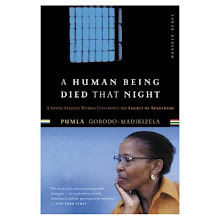
"A Human Being Died That Night" Pumla Gobodo-Madikizela is an account of a Mass murderer, a commanding  officer of state sanctioned apartheid death squads, who is currently serving 212 years in jail for crimes against humanity. Gobodo-Madikzela who grew up in a black township in South Africa  served alongside Desmond Tutu as a psychologist on the Truth and Reconciliation Committee.  She enters Pretoria's maximum state prison to interview the man called "Prime Evil" and she embarks into a deep journey where she witnesses the complexities and paradox of what it means to be  human as she delves into the darkness of his evil  and unravels the remorse and apologies surrounding his atrocities of the murder of black Africans. The book opens up a chilling question in the wake of the xenophobia issues that are present in the New South Africa where people are turning against their brothers and sisters who are in the same situation. What does it mean when the incarnation of evil is as frighteningly human as we are? 

COSATU:the Congress of South African Trade Unions wrote on May 30,"COSATU has done everything in its power to give voice to the voiceless and speak out against the intolerable levels of unemployment and poverty in South Africa. "It is therefore shocking  and disturbing to see that some workers and residents of poor communities believe that these problems are caused by foreign nationals and that they are attacking,  robbing and killing those foreigners they believe to be responsible, who are themselves victims of the same unemployment, poverty and crime "   

Only by remembering the past can people look to a better future-truth however accompanies pain- and in the light of today's xenophobia it is a reminder that reconciliation may be a distant dream, a fading hope in the new South Africa. How can reconciliation  truly begin when the   promises to eradicate poverty, unemployment and find money for HIV and AIDS have been broken. Betrayal after trust and hope is indeed a deep wound  and when the wound has been unattended as it has in the New South Africa where the trauma of apartheid becomes the dis-ease then we are simply deepening each cut by adding layer after layer of suffering. The Black South Africans are a strong and resilient people but human and there is only so much humans can take. Yet in one of the richest countries of the world there is still not enough. Are they really fighting the strangers who are like them or are they fighting the deep betrayal that festers in their bones. As my South African brother said "There is much healing to be done" 

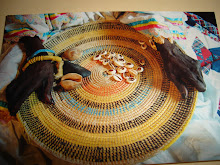
The beautiful image is a series of artwork inspired by Madelaine Georgette inspired by the TRC
www.studiogeorgette.com/image/specialexhibitionsTRC.htm

Sunday, May 4, 2008

Orphans on the grave of their parents lost to AIDS- South Africa


 Mme Ma Africa (Sotho)
Dikhutsana
Difeng Marobalo
Ditlatsuha Ditsamaya

Mother of the Nation/mother Africa
be kind to the orphans
give them a place to sleep;
they will be gone tomorrow


" Like slavery and apartheid, poverty is not natural. It is man -made and it can be overcome and eradicated by the actions of human beings.' Nelson Mandala, Former President South Africa
 
I have recently completed my first day working at a needle exchange program in Oakland. It was a deeply touching experience. Men women and youth, most who were homeless, came to talk, drink coffee, eat breakfast cereal and exchange their needles for clean ones, and refresh their condom supply.  We were deep in the heart of East Oakland, where a young man who was a resident of the homeless shelter where I work  was recently caught in gun fire while riding his bike in the streets of his neighborhood. Where last year a young black man shared with me that he was too scared to leave his house for his Dialyis treatment for fear of being shot, he has since passed his diabetes and kidneys finally took his life, he was 24 years old.

 Mostly, each one that shuffled up was black. I asked a man how he was doing as he stood resting by a the fence trying to catch his breath his eyes weeping with a white liquid that oozed from the sides of his eyes, his fingernails so long they curled over the tips of his fingers, where the dirt ingrained behind the nails constantly reminded him of the squalor of nights sleeping on the sidewalk. "Blessed" he replied as he squeezed a toothless smile. I turned away so he would not see the tears that caught me by surprise, the ones that catch you in your throat when the suffering you witness daily is pushed into a recess, but without warning they overflow. His girlfriend came to stand by him they spoke gently to each other and leaned into the bond they shared maybe they were in love and maybe the bond was their addiction, whatever it was it bound them together for the moments when they were coming down.  She asked about her HIV results while he drifted into a stare that is borne of years of shooting up looking for that high- the first one,  when you knew that you were golden. They say if you have not experienced that golden moment you die inside, maybe thats what she did, make him feel like gold. Some may say we are encouraging the drug addicts to continue. With HIV and AIDS so rampant any  choices made to prevent the spread of disease and the education that accomapanies it is a wise and responsible choice. 

  They approached the table with a trust of knowing there was no judgement in the eyes that served them. My heart cracked open each time I looked into the face of suffering, poverty, homelessness and addiction. Each set of eyes held mine sometimes only briefly and what I saw was the longing in the mirror to the lost soul, the eyes behind the eyes. Children do not hide this, they dont know how to. Their eyes are raw, in your face, they tell of loss, of poverty and longing and ask what is happening in this world. 

In contrast that night I drove to Napa Valley with my choir Vukani Mawethu to perform at a fund raising Benefit for The Ubuntu Education Fund. ubuntufund.org.  We walked into a three million dollar property where young wealthy people were gathered for the common purpose of raising money for an HIV and AIDS Project in Port Elizabeth, South Africa.  Fine food and excellent wine was served, it was another world. They spoke about Ubuntu and how the 21 one year old white South African young man who in 1998, founded with a black man Ubuntufund where together they now provide life saving education and health resources to over 40,000 children. They go into the townships that remind us on a daily basis we are here, in poverty and have a right to live in dignity.         

Recently the REV, Jeremiah Wright, Barack Obama's former pastor, blamed the government for "inventing the HIV virus as a means of genocide against people of color." Wright is not the first to say that AIDS originated in the White House,  others have attributed the epidemic to a laboratory accident, and  malnutrition.  Among the most popular and pernicious theories is that AIDS is not a caused by a virus at all. Peter Duesberg, a biology professor at University of California-Berkeley, has argued that drugs and promiscuity are the principle causes of the disease and that in Africa it is malnutrition.

The inability to fight HIV and AIDS is connected to a deficient immune system so the ability to fight the disease becomes almost impossible for those who live in poverty, and with malnutrition fewer people are  likely to survive. In addition as in South Africa water and clean water are also major factors in the poverty war and the fight against aids. Money in terms of fund raising is not necesarily being used for these issues. We are told it is being used to buy drugs to fight the disease. The drugs are so expensive that the Africans cannot afford to buy them so the pharmaceutical companies continue to get richer while the water stays dirty, and we continue to have blood on our hands each time another child dies.  I know many people here who have been  living with HIV for years. They are not in poverty or have malnutrition. 
The question remains where did it come from?

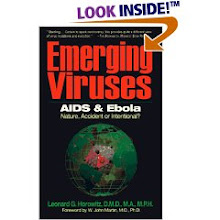
 Two years ago when I visited Credo Mutwa  in Kuruman, in the middle of the bush. He said to me "Madam, Africa is dying from this disease, AIDS is a man made disease. I ask that who ever is killing our children , to please stop!"   In an interview with Rick Martin, Mutwa  quoted the name of the man, a Dr. Robert Gallo. Martin referenced the following: See Len Horowitz's monumental book Emerging Viruses: AIDS and Ebola; Nature, Accident or Intentional for a wealth of documentation placing Dr.Gallo longtime head of the National Institute of Health (NHI) and National Cancers Institute (NCI) Section on Cellular Control Mechanisms, at center stage in the AIDS arena.  Evidence suggests that he created the AIDS virus about a decade ago before he received a lot of political accolades for having discovered it. The text hauntingly dissects the potential motives and administrative mechanisms underlying the prevalent belief that HIV and Ebola may have been deliberately deployed and that the AIDS epidemic may be accomplishing what was desired.

Mutwa speaks with passion and desperation about the children of Africa. In sub-Saharan Africa there are close to 44 million people with AIDS , but the South African newspapers dare not print the true stories about AIDS. Bertrand Russell he states said that the Western nations would have to decimate Black people, using war, famine, and disease. And this has happened.
I encourage you to read a fascinating article posted on Mutwa's website,  credomutwa.com/about/biography-09/    

In South Africa now more than one out of eight black South Africans is HIV positive.  Jonny Steinberg a Johannesburg newspaper columnist and author of the book "Sizwes Test"  A young man's journey through Africa's AIDS Epidemic recently reported that 800 people die of AIDS DAILY. His book is presented through the eyes of one man who he calls Sizwe Magadla, who is  30 years old and lives in Lusikisiki, Eastern Cape Province.  It is a rural black overcrowded slum. The area has a well stocked first rate AIDS treatment program and yet one in three pregnant women are HIV positive. In the book he unravels the layers of the complex social network that reveals the stigmas and realities of why people may not be willing to be treated. "There's an even deeper layer to people's resistance to testing and treatment" he goes onto say that as with  many indigenous people the sickness  is seen as something sent to you by those who wish you ill. If whites already took away so much farmland, mineral and wealth, the thinking goes, could not the very needle the white doctor or his nurses use to draw blood be what's spreading AIDS in the first place ? And if an enemy does attack you, what more deadly way than with an illness that seems connected to a mans potency and ability to procreate. Men are anxious about this the world over, but nowhere more so than when,  in desperate poverty they posses little else. This theory is not a new one, and when it comes to so many people especially the indigenous ones, then I trust the wisdom of the old ones.  
 Mutwa, and  Sizwe are simple humble men, Mutwa will be the first to tell you so, and they are also men who are profoundly insightful and sharp. I leave you with this question from Micheal Meade "What story are we in when those carrying the dream of life increasingly find themselves near the door of death?" mosaicvoices.org 
Ubuntu says my humanity is inextricably bound up in yours and I cant help but see in the eyes of the young ones in the above image, the question to me and you   "What have we humans done?"   
             

Friday, April 11, 2008

In Honor of the Mother Line

My mother is in the middle with her mother and two sisters

April 17, today is the annivesary of my mothers death , Doreen Marais, and I dedicate this blog to her and honor the mother line of my family and all mothers everywhere. What I know and love to remember about my mother was her strength and her peace making. A school teacher for some of her time on this earth, I know she loved to guide the kids in creative projects. As a young woman she was a strong runner something I inherited from her for a time. One story she told was when she jumped her first hurdle, she was running from a cobra who was chasing her! She kept our family together when it must have been a struggle to settle in a brand new alien land (London) from South Africa. She had an adventurous spirit and a wonder lust for travel. Every year she saved enough money from my father's low salary as a teacher, to travel all over Europe. She loved having family around her at all times infact she lived for those moments when we were all together.

I loved Easter as a little girl! My mother would curl my hair in ringlets with her finger, and dress me in a party dress, white socks and shoes and take me to Battersea funfair. She told me to never go to bed with a partner on an argument and if she were gay she would like to be with Ingrid Bergman! At Christmas when all our relatives gathered and at times there were as many as 25 she would insist that no matter where we were we had to come home in time for midnight on Christmas Eve and it was ok to bring all our friends with us. My mother carried the spirit of Ubuntu and the South African hospitality that she knew, it was extended to ALL who came across her path. She was a rock, a solid being. Her door was always open to any family member or stranger that happened to knock on the blue door with the black knocker. She was raised by the hand on occasion and in our family she tended to be the one to give out the punishment. If she hit us she would go and cry in her bedroom as it hurt her to do that.

She died of lung cancer 10 years ago today. I believe the deep grief she carried was for the loss of her life partner, lover and friend my father who died in his early fifties and the fact that as the years went on we all went our ways and the family nucleus that she loved so, became disconnected. My mother though was a pretty progressive woman, with a sardonic but sharp sense of humor and she loved to lose her self in the cinema, often leaving us all to sneak into a movie by herself. It was her way of finding some peace and solace, far from the "maddening crowd" which I know we could all be at times.

I don't remember her controlling us, her own love of adventure only served as a mirror for us to draw from and I certainly inherit that from her. Nieces and nephews often went to her to seek her counsel arond love, relationships and their own mothers. She counseled with love and compassion often teaching about the importance of forgiveness and tolerance her wisdom born out of many years of a curious match with my father, an introverted man of integrity and substance.

After she passed she left me a little money and I was able to return to the USA which I had visited the year before for the first time. It allowed me a years sabbatical and I returned to live, this has changed the course of my life, my soul work time and time again and for that I am deeply grateful. I stayed with a friend in Laguna Beach in a house overlooking the Ocean. One hot summers day I dozed off on the deck and was dreaming of her, she came to tell me she was alright. I awoke with a start to find a huge bird sitting quietly watching me, I believe it was her messenger.

Her mother, grandma Elizabeth was quite something else. A white skinned colored woman that sometimes laid the sharp end of the heel of her high heeled shoes on our unsuspecting buttocks. Her expression of rage was I believe due to the indiginty she suffered of having to leave her homeland because she refused to be treated inhumanely. She was always dressed immaculately and sometimes sat at the dinner table wearing a hat. Her head was cocked high with dignity. (see picture on right) She often used to tell me to hold my head up high. Aparantly I heard from a friend in South Africa who knew her, that, that generation were devoted to Queen Elizabeth, they wanted to copy her! Royalists and Queen groupies who dressed like her! I carry a second name of Elizabeth. These women were powerful in their way. I am honored that they now stand behind me in line as ancestors. I feel their strength, I carry their strength as do all my beautiful neices, their grandaughters, great grandaughters. They say when the mother dies your soul work begins -and so it was. I love and miss you.